
Win–Win Solutions for Port Ecosystems
PORTAL improves the resilience and sustainability of port infrastructure and interdependent socio-ecological systems (Port Cities) by combining nature-based measures, digital technologies, and a threat-agnostic resilience approach.
Three solution pillars

Nature-Based Solutions (NBS)
Nature-Based Solutions use natural processes (or nature-inspired design) to reduce risk while delivering ecosystem and social co-benefits.
- Risk reduction through buffering and absorption (e.g., waves, flooding, erosion) while supporting operational continuity.
- Environmental co-benefits such as improved air/water quality and biodiversity.
- Higher social acceptance when measures deliver visible benefits to communities alongside protection.
Learn more
In PORTAL, NBS sit within a broader adaptation library that prioritises no-regret, low-regret, and win–win measures. We assess NBS not only on hazard mitigation, but also on co-benefits and trade-offs across economic, environmental, social, and governance dimensions.
PORTAL in practice
- NBS are captured and prioritised in the open adaptation library.
- Co-benefits and trade-offs are evaluated to support evidence-based investment decisions.

Digital Twins & Generative AI (GenAI)
A Digital Twin is a data-driven representation of a port system used to test disruptions and adaptation options; GenAI helps explore plausible scenarios beyond historical data.
- System insight: integrates multi-source data (e.g., GIS and operational data) to represent performance and interdependencies.
- Cascading-failure analysis: identifies bottlenecks and vulnerabilities under disruption.
- Decision support: enables scenario testing and supports stakeholder engagement through visualisation and training.
Learn more
PORTAL uses GenAI and adversarial learning to generate synthetic threat-agnostic scenarios, including compound and high-impact low-probability events. These scenarios are explored through Digital Twins and modelling tools to understand disruption propagation.
PORTAL in practice
- Digital Twins and modelling simulate disruptions and adaptation options within the three use cases.
- Outputs feed into PORTALCOMM to communicate results to operators, policymakers, and communities.
Threat-Agnostic Resilience
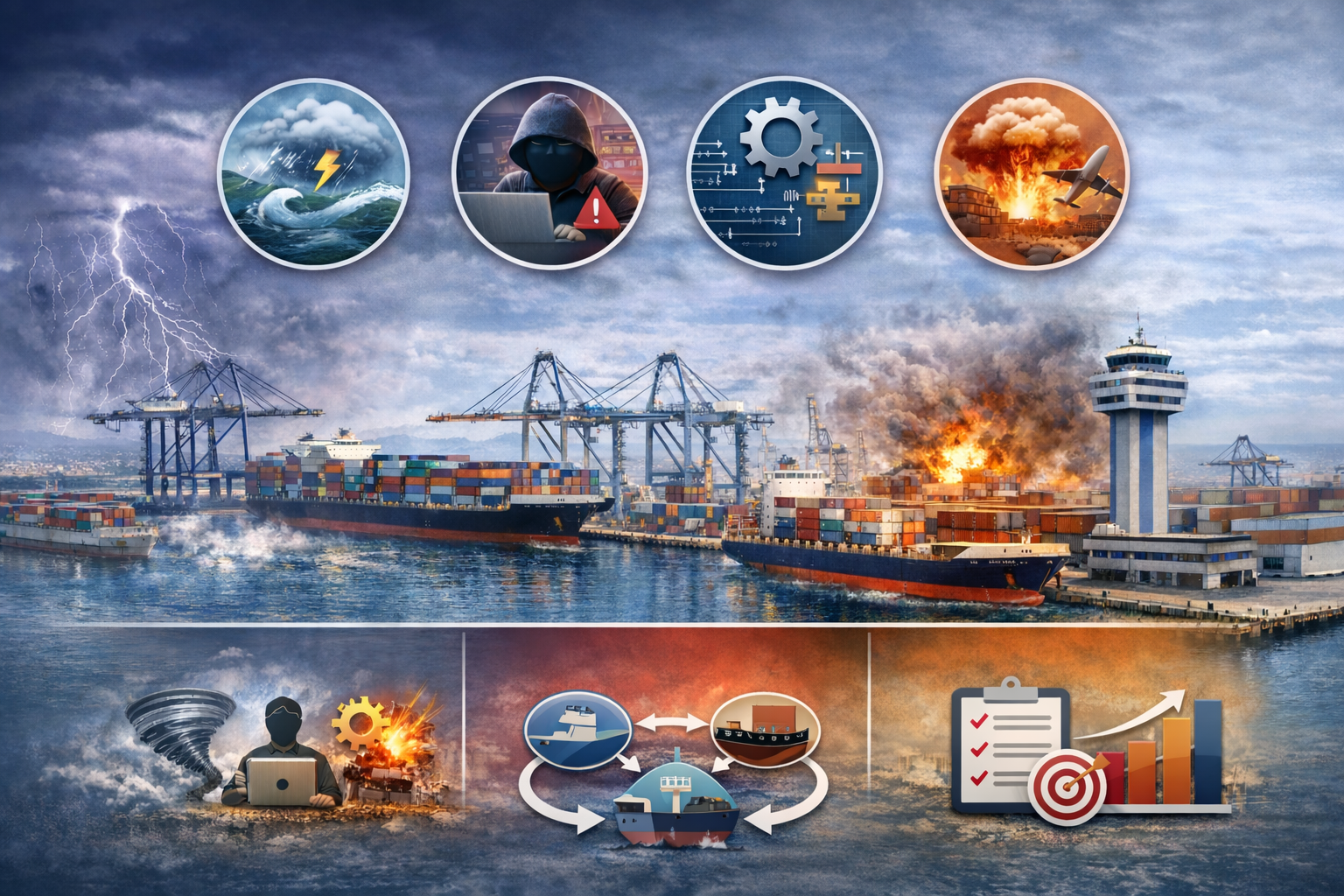
Threat-agnostic resilience keeps critical port functions working under known and unknown threats, rather than optimising only for a shortlist of anticipated hazards.
- Future-proofing: accounts for natural hazards, human stressors, technological accidents, and compound/high-impact events.
- Systems focus: targets interdependencies (intra-port and inter-port) to reduce cascading losses.
- Benchmarking & prioritisation: supports resilience benchmarks and fit-for-purpose adaptation measures.
Learn more
In PORTAL, threat-agnostic resilience starts with mapping PISCO as a socio-ecological system. This mapping underpins scenario generation and cascading-failure analysis, grounding adaptation choices in how the port ecosystem functions.
PORTAL in practice
- Threat-agnostic scenarios are translated into functionality losses to examine disruption pathways.
- Cascading failures are analysed to identify critical nodes and guide efficient adaptation.
How they work together
A practical workflow from system understanding to scenario generation, testing, and communication.
-
Map Port-cities interdependenciesIdentify assets, services, ecosystems, governance and critical dependencies.
-
Generate scenariosCreate plausible disruption patterns, including compound and unknown threats.
-
Test measuresEvaluate NBS, grey and hybrid options through modelling and Digital Twins.
-
Communicate & trainTranslate results into actionable guidance via PORTALCOMM and stakeholder engagement.